CloudFlare provides web performance and security solutions, enhancing site speed and protecting against threats.
Service URL: developers.cloudflare.com (opens in a new window)
cf_ob_info
The cf_ob_info cookie provides information on: The HTTP Status Code returned by the origin web server. The Ray ID of the original failed request. The data center serving the traffic
session
__cfseq
Sequence rules uses cookies to track the order of requests a user has made and the time between requests and makes them available via Cloudflare Rules. This allows you to write rules that match valid or invalid sequences. The specific cookies used to validate sequences are called sequence cookies.
session
cf_clearance
Whether a CAPTCHA or Javascript challenge has been solved.
session
_cfuvid
The _cfuvid cookie is only set when a site uses this option in a Rate Limiting Rule, and is only used to allow the Cloudflare WAF to distinguish individual users who share the same IP address.
session
__cflb
When enabling session affinity with Cloudflare Load Balancer, Cloudflare sets a __cflb cookie with a unique value on the first response to the requesting client. Cloudflare routes future requests to the same origin, optimizing network resource usage. In the event of a failover, Cloudflare sets a new __cflb cookie to direct future requests to the failover pool.
session
__cf_bm
Cloudflare's bot products identify and mitigate automated traffic to protect your site from bad bots. Cloudflare places the __cf_bm cookie on End User devices that access Customer sites that are protected by Bot Management or Bot Fight Mode. The __cf_bm cookie is necessary for the proper functioning of these bot solutions.
session
__cfruid
Used by the content network, Cloudflare, to identify trusted web traffic.
session
cf_chl_rc_m
These cookies are for internal use which allows Cloudflare to identify production issues on clients.
session
cf_chl_rc_ni
These cookies are for internal use which allows Cloudflare to identify production issues on clients.
session
cf_chl_rc_i
These cookies are for internal use which allows Cloudflare to identify production issues on clients.
session
__cfwaitingroom
The __cfwaitingroom cookie is only used to track visitors that access a waiting room enabled host and path combination for a zone. Visitors using a browser that does not accept cookies cannot visit the host and path combination while the waiting room is active.
session
cf_use_ob
The cf_use_ob cookie informs Cloudflare to fetch the requested resource from the Always Online cache on the designated port. Applicable values are: 0, 80, and 443. The cf_ob_info and cf_use_ob cookies are persistent cookies that expire after 30 seconds.
session



Corey I can’t watch the entire tutorial probably there’s some technical problem,I caan watch only haalf way!!!!!!
I solved the problem….the tutorial is great as usual keep feed us…….
Very cool and different, Larry, very cool
I can’t see the tutouials , do I need to subcribe to view ?
yet another great tutorial.
Why does the background layer have to be converted to a smart object?
Very cool tutorial as always! 🙂
The easiest way to center sg. is to select all (command or ctlr + a) and then press the align botton at the top bar (with the move tool selected).
It’s called “Align Layers to Selection” from the Layer menu.
Hi Fatboise
I’m not sure but when you will apply many free transform commands to a layer(when the results are not so good in the end) convert it to a smart object is a good choice. This way PS will make the changes to a kind of “scratch” of the layer and only one real transformation will be applyed, when everything is ok. This is a non destructive way to resize a layer many times. You can see how they are called “smart” looking for Julieane Kost’s video tutorials on Adobe TV.
Hope it can help you and sorry for my poor english
Marcelo – Brazil.
Where’s corey? Your voice is too deep and i cant understand what the hell your saying.
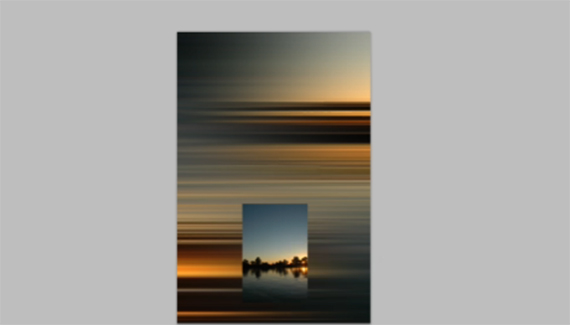
Larry, I played with this for awhile and found it can be very good, instead of doing the mask thing with the gradient, try turning one vertical and the other horizontal, it will give you a plaid look that will without a doubt go with the pic you took the colors from, another thing you could do is turn the angles to a 45 degree angle and a 135 degree angle the thing is with one you get that plaid that looks like squares, or the other a plaid that looks like X’s. My point is this works great Larry and if you play with blend-modes and the opacity you are bound to come up with something cool, I have so many that i’ve made with spacific pics for my kids and then saved them for use with other pics. Again great technique thanks
Ken
PS this is larry becker not corey barker right? http://www.flickr.com/photos/dundalkphotowalk/5088550479/ thanks agian
My pictures won’t blend together using the gradient tool. I created the mask layer and dragged the foreground to background gradient tool exactly as you described, but nothing happened. Can you please tell me the reason?